
Karyotyping
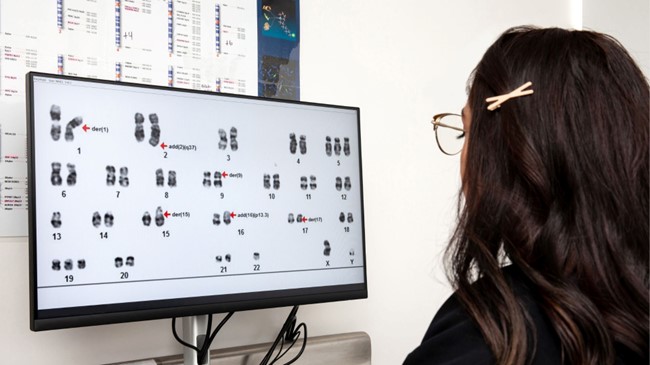
During the karyotyping process, all chromosomes found in cells are paired and arranged in order, providing a comprehensive view of an individual's chromosomal makeup. Karyotypes are typically created using staining procedures that make the characteristic structural features of each chromosome clearly visible.
Cytogenetic testing can reveal large-scale genetic abnormalities—typically affecting millions of base pairs. For example, changes in chromosome number (aneuploidies) can be detected, such as trisomy 21 (Down syndrome).
What Karyotyping Can Detect
- Chromosomal number changes (aneuploidies)
- Trisomy 21 (Down syndrome)
- Deletions (missing chromosome segments)
- Duplications (extra chromosome segments)
- Translocations (chromosomal rearrangements)
- Inversions (reversed chromosome segments)
Clinical Significance
- May contribute to infertility issues
- Can cause recurrent miscarriages
- Associated with developmental disorders
- Often carried unknowingly by individuals
- Important for family planning decisions
- Enables genetic counseling opportunities
Detailed analysis of karyotypes can also detect more subtle structural abnormalities, such as deletions (missing chromosome segments), duplications (extra segments), translocations (rearrangements), or inversions (segments that are reversed in orientation).
It may happen that someone unknowingly carries abnormalities in their chromosomes—this can contribute to infertility, recurrent miscarriages, or developmental disorders.
New Option: Microarray-based Karyotyping (CMA)
CMA (Chromosomal Microarray Analysis) is also available at our clinic, which can detect imbalanced chromosomal abnormalities with much higher resolution than classical karyotyping—meaning the absence or excess of genetic material (copy number variation, CNV).
During CMA testing, the entire genome is analyzed with a single test, and smaller abnormalities that traditional methods cannot detect can be identified. The method is more sensitive to recognizing subtle structural disorders, thus increasing diagnostic efficiency, especially in complex infertility or developmental problems.
Advantages of CMA Technology
- Much higher resolution than classical karyotyping
- Whole genome analysis in single test
- Detects smaller abnormalities missed by traditional methods
- More sensitive to subtle structural disorders
- Increased diagnostic efficiency
- Particularly valuable for complex cases
Who Should Consider This Test?
- Every couple planning to have children
- Those considering pregnancy now or in the near future
- Couples with unexplained infertility
- Individuals with family history of genetic disorders
- Those with recurrent pregnancy loss
- Anyone seeking comprehensive genetic screening
How the Test is Performed
Simple and Straightforward Process
The process begins with a simple blood draw. The collected sample is analyzed in a cytogenetics laboratory: chromosomes are organized based on their size and characteristic banding patterns, and recorded in image form—this is called karyotyping.
Results are typically available in approximately 2–4 weeks.
Testing Process Steps
- Simple blood draw procedure
- Sample sent to cytogenetics laboratory
- Chromosomes organized by size and banding patterns
- Results recorded in detailed image form
- Comprehensive analysis and interpretation
- Results available in 2-4 weeks
What to Expect
- No special preparation required
- Quick and painless blood collection
- Professional laboratory analysis
- Detailed genetic report provided
- Genetic counseling available
- Follow-up consultation if needed
Advanced Chromosomal Analysis for Better Health Planning
Our karyotyping services, including advanced CMA technology, provide essential insights into chromosomal health, enabling informed decisions about family planning and reproductive health with the highest standards of genetic testing.